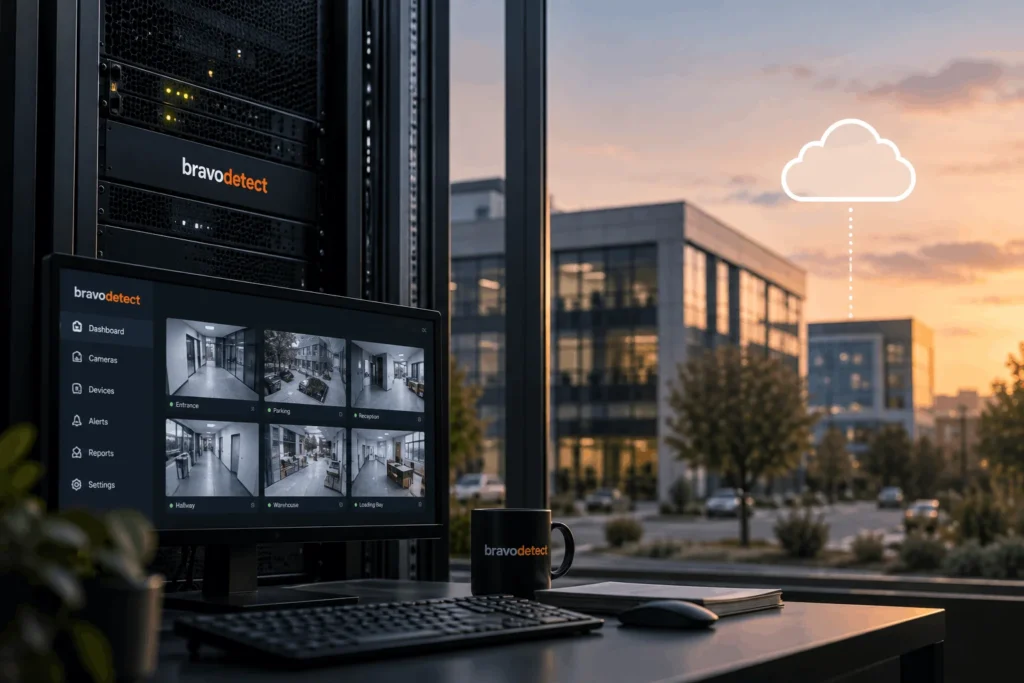
Every security lead eventually has this conversation with IT: on-premise vs cloud CCTV monitoring should device monitoring live in the cloud, or stay entirely inside the building? For a lot of software categories, cloud wins on convenience alone. For CCTV and IP device health monitoring in a regulated environment, the answer usually comes down to a short list of constraints rather than a preference.
Start with what the network is allowed to do
Banks, pharmaceutical warehouses, defence-adjacent sites and many hospital wings run networks that are deliberately isolated. GMP and data integrity requirements, banking regulations and hospital IT policies can rule out a cloud-dependent service before organizations even compare features. If the network is air-gapped by design, the on-premise vs cloud CCTV monitoring decision becomes much more straightforward: a cloud-dependent tool may not be suitable, regardless of how advanced its dashboard is.
bravodetect was built around this constraint from the beginning. The entire discovery, monitoring, alerting and reporting process runs on one Windows Server and SQL Server machine inside the building. Nothing is uploaded, and nothing calls home. The system can continue monitoring CCTV and IP devices even when the network has no connection to the outside world.
All traffic stays inside your LAN.
Then ask who owns the evidence
Uptime and coverage reports often end up as evidence: for an insurer after an incident, for a regulator during an inspection, for an accreditation body renewing a certificate. Whoever holds that evidence effectively controls how it can be used and how quickly it can be produced.
Keeping the record on premise means the building’s own team can pull a report the moment it is asked for, without waiting on a vendor’s support desk or worrying about a subscription lapsing at an inconvenient time. It also means device credentials, encrypted at rest, never leave the property either.
On-Premise vs Cloud CCTV Monitoring
The choice between on-premise and cloud CCTV monitoring also affects scalability, maintenance, remote access and long-term operational planning. On-premise systems give organizations greater control over software updates, server configuration and network architecture, which can be important when security policies require tightly managed infrastructure. Cloud monitoring can simplify expansion across geographically distributed locations by reducing the need to maintain monitoring servers at every site. Organizations should also consider bandwidth availability, backup strategies, disaster recovery, system redundancy and the technical expertise required to maintain the chosen environment. Evaluating these factors alongside security and compliance requirements can help create a deployment strategy that remains practical as operations grow.
Where a hosted option still makes sense
Not every site has the same constraints. A single hotel or a small retail chain without regulatory pressure may prefer someone else to manage the server, patch it, and take backups, in exchange for a subscription. That trade is reasonable when the constraint list is short.
- If your network must stay air gapped, on premise is not a preference, it is the requirement
- If audits or insurers will ask for evidence, decide in advance who can produce it fastest
- If your IT team already runs Windows Server and SQL Server elsewhere, on premise adds no new skills to the roster
- If you have no in house IT capacity at all, a hosted option removes that burden, at the cost of a recurring dependency
The practical middle ground
bravodetect, built by ScoreTech Vision, is licensed per deployment so that a single building and a multi-campus enterprise can use the same on-premise monitoring model without paying for infrastructure they do not need. From one server to a fleet of deployments across multiple sites, bravodetect provides a flexible approach to CCTV and IP device health monitoring. Once the actual network, security, compliance and IT requirements are clearly defined, the right deployment model becomes much easier to determine.